

Demystifying µg/cm2---ppm---mg/m2---mg/l---µS/cm
Confused ?
Article by: Jerry J. Colahan (Chlor*Test)
Chandler, AZ 85244
Introduction
Over the past several years I have received numerous calls from contractors reviewing surface
preparation specifications that did not clearly and accurately state what limits of salt contamination were required.
This omission leads to misunderstandings, subjective interpretations, work stoppages and, in some instances, litigation.
Demystifying this coating industry jargon requires some degree of expertise and understanding. It is clearly desirable to have a work plan submittal from the contractor and a pre-job conference for each project to engineer-out potential future problems and misunderstandings before they occur. To accomplish this, both (all) parties need to fully comprehend the terms used to describe the level of salt contamination on a surface.
SALTS-Units of Expression
In the US the most common accepted terminology in the coating industry for expressing salt on a surface, for field usage, is µg/cm2 (micrograms per square centimeter – not micrograms per centimeter squared).
It is the weight of salt (ion specific) i.e. chloride, nitrate and or sulfate per unit area ( in our case, per square centimeter). Conductivity may sometimes be used but, at this time, it is more prone to inaccuracies as discussed later in this article.
Demystifying
Let’s dissect µg/cm2. The symbol “µ” is a lower case Greek letter “m” pronounced “mew”.1 It means minute (mi-noot) as in very small or tiny. This “very small” unit has transitioned to mean micro as in microscopic, not being visible with the unaided eye.2 It is a measure of one millionth part of a specific unit and in our case a gram. The “g” stands for gram(s) as in weight. One gram is the weight in a “Sweet’n Low” packet. Never write gm for gram. The abbreviated term “µg” becomes microgram(s) (0.000001 gram). That other term, mg, means milligram(s) (0.001 gram).
One microgram of chloride ions contains approximately 9,000,000,000,000,000 (quadrillion) ions. (And your specification allows how much!?) The “/” symbol means “per” as in “for every” or “divided by”. The “cm” is short for centimeter(s) as in length measurement and the superscript “2” means square (two dimensional i.e. length and width).
However, in the engineering world when these are put together it is said aloud as, “per square centimeter”. When all is written together it is stated as, micrograms per square centimeter (µg/cm2). It is a weight (µg) or amount per surface area (cm2) measurement.
PPM
Is PPM (parts per million) self explanatory? The phrase “25 ppm” means there are 25 parts (of interest) for each one million parts being considered. Titration or analysis of an extracted solution used for salt testing in the field is also read as ppm.
However, when the level of salts on a surface became of interest to the painting industry, the temptation was and still is by some, to use the relatively understood concept of ppm. But the use of ppm in the context of indicating levels of salt on a surface is incorrect. When we only know the ppm of salt in solution, the level of salt contamination on the surface cannot be computed.
PPM accurately indicates the amount of salt in a volume of liquid but we in the painting industry need to know how much salt is on a known surface area not what is in the extracted solution only.
When salts are extracted and analyzed (ppm) in a solution taken from a known volume of liquid
(ml) and a known surface area (cm2), we can then accurately calculate the amount of salt per unit
of surface area (µg/cm2).
In order to avoid these calculations, it is possible to pre size the wash sample area and pre size
the amount of wash solution such that the numerical value for ppm is the same as µg/cm2.3 This
can be functionally engineered into a surface salt to get TABLE 1 Multiplyest kit which would increase the reliability and reproducibility of salt testing. However this is not the normal relationship between ppm and
µg/cm2.
mg/m2
Some specifications use mg/m2 (milligrams per square meter). The conversion from mg/m2 to
µg/cm2 is to divide the number (mg) by ten and simply change the units. For example; 25mg/m2
is the same as 2.5µg/cm2. This terminology is more often used in Europe than in the US. The
conversion from µg/cm2 to mg/m2 is to multiply the number (µg) by ten and change the units.
For example; 7µg/cm2 is the same as 70mg/m2. These conversions are precise.
Conductivity
The conductivity of a solution is read as Siemens (S) and can be subdivided into units such as
microSiemens (µS) and for a specific area - microSiemens per centimeter (µS/cm). Though
conductivity is usually based on a cubic centimeter (cm3) it is not stated as such. For us “old
timers” it used to be called micromhos, pronounced micro-mows.
Conductivity is a measure of the ability to transmit electrical current, in our case through an
electrolyte, between two distant points converted to a known distance of one centimeter. The
ability to conduct electrical current represents the “total” conductive ions (not ion specific)
within the solution. In field usage, the solution should have been taken from a pre tested
(conductivity of the wash solution prior to washing); pre measured volume of DI (deionized)
water and washed from a measured surface area. The pre tested conductivity is subtracted from
the extracted solution conductivity which then allows a calculated approximation of chloride ions
per unit area. Recognizing that the product of anything multiplied or divided by a doubtful figure
is also doubtful. It is therefore assumed that ALL or most of the measured conductivity is due to
the chloride ion.4 However the chloride ion (Cl-) cannot be calculated precisely from this
procedure because of the probability of other salts contributing to the conductivity. In some
instances there may be no chloride ions yet there will be significant conductivity.
Table 1 contains “Rules of Thumb” (assumptions) that are sometimes used for converting
conductivity to chlorides.
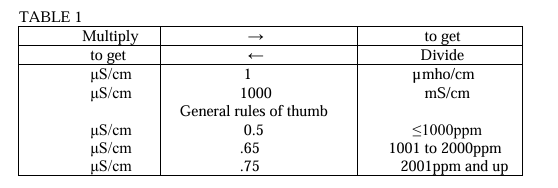
General rule of thumb:
Sea Water has a TDS (total dissolved solids-- if all were sodium chloride - NaCl) of ~35,000ppm; therefore Sea Water has ~46,666µS/cm. Therefore Sea Water has ~ 21,231 ppm Cl
.
Another rule of thumb (assumption) reverse to Table 1 is:
To convert low conductivities up to 1000 microSiemens directly to ppm Cl- divide by 4. For
conductivities between 1000 to 2000 divide by 3.5 and for over 2000 divide by 3.25. Generally the higher the conductivity the more out of proportion this rule of thumb becomes for determining Cl-.
Conclusion
The coating industry’s diverse \ terminology requires each participant in a coatings project, from specification writer to contractor to inspector to clearly understand the other. Clear and concise written specifications are the first step toward derailing potential misunderstandings. The second step is a detailed written work plan submitted by the contractor that clearly and concisely describes the sequential procedures. The third step is to hold a pre job conference whereby the interested parties sequentially scrutinize and compare the specification to the work plan. This “triple check” will demystify the mumbo jumbo that may have led to disorder.
References:
1 Darrell D. Ebbing, R.A.D. Wentworth, “Introduction to Chemistry”, Houghton Mifflin Company, Second Edition,
1998, p22
2 Webster’s College Dictionary, Random House, NY, 1991, p855
3 CHLOR RID International, Inc., CHLOR*TEST, kit directions, 1997
4 GUIDE 15 (old TU-4), “Method of Retrieval and Analysis of Soluble Salts on Steel and Other Nonporous
Substrates”, 2003, SSPC